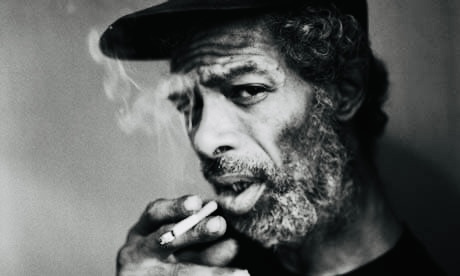
Gil Scott-Heron

Life inevitably translates into time. That’s why the sum total of it is called a ‘lifetime.’ Freedom is the potential to spend one’s time in any fashion one determines. I would always want the time invested in my ideas to be profitable, to give the reader something lasting for their investment in me. It is very important to me that my ideas be understood. It is not as important that I be understood. I believe that this is a matter of respect; your most significant asset is your time and your commitment to invest a portion of it considering my ideas means it is worth a sincere attempt on my part to transmit the essence of the idea. If you are looking, I want to make sure that there is something here for you to find.
The public ‘lifetime’ of an artist is comparable to that of an athlete—about 5 years. From the thousands of individuals who consider themselves candidates for visibility and public notice, few make it. I have been blessed by the grace of the spirits with the public’s attention for nearly six of those lifetimes—songs that I have sung and poems that I have written have been heard on every continent, in every country where people have records and books. How could I possibly complain?
But even if you have heard my work sung or recited in the past, perhaps reading my poems in the future may offer you a fresh perspective on some of my ideas.
You don’t think that rap is a brand new style?
No. In fact folks been rapping for a good little while.
Which brings us to why I am reluctant to accept the title of ‘Godfather of Rap.’ There still seems to be a need within our community to have what the griot supplied in terms of historical chronology; a way to identify and classify events in black culture that were both historically influential and still relevant. In basketball for example, Michael Jordan was the first ‘Skywalker’ unless you’d seen David Thompson. Dr. J was the only ‘Surgeon and General’ who could rebound like a center, take the ball full court like a guard and dunk like nobody’s business—unless you’d seen Connie Hawkins. In the same way, there were poets before me who had great influence on the language and the way it was performed and recorded: Oscar Brown Jr, Melvin Van Peebles and Amiri Baraka (a.k.a. LeRoi Jones) were all published and well respected for their poetry, plays, songs and a range of other artistic achievements when the only thing I was taping were my ankles before basketball practice.
It was The Last Poets (both groups), and their percussion-driven group deliveries, who made the recordings which serve to place my title as ‘Godfather’ in question. If there was any individual initiative that I was responsible for, it might have been that there was music in certain poems of mine, with complete progressions and repeating ‘hooks,’ which made them more like songs than just recitations with percussion. I put this down to my background as a piano player prior to my attempts as a songwriter or to writing poems that could be performed in a musical setting.
The character of those pieces, particularly the early ones, brought about descriptions and analyses from journalists and critics that not only took in the metric and rhythmic values of them as poems or songs, but stumbled to conclusions about our philosophy. Because there were political elements in a few numbers, handy political labels were slapped across the body of our work, labels that maintain their innuendo of disapproval to this day. Words like ‘radical’ and ‘militant’ and ‘muckraker’ stuck out in the reviews like weeds in a rose garden. Those terms were amusing at first because we had no idea that they were terminal. We attributed them to idiots under the pressure of editor-inspired deadlines who had not bothered with the words, but responded only to the street-sound drumbeats that sounded as if they were calling for the revolution that so many journalists in the late ‘60s thought would bring the end of the world.
So if it ain’t exactly rap, and it ain’t exactly radical militant muckraking, what is it? Because of the contributions of Ron Carter and Hubert Laws on Pieces of a Man and the background of Bob Thiele, the owner-producer of The Flying Dutchman record label as a ‘jazz’ producer, Brian Jackson and I became ‘jazz artists.’ It certainly couldn’t have been because of guitarist Bert Jones or drummer Bernard Purdie, and I doubt if it was because of ‘The Revolution Will Not Be Televised’ or ‘Save The Children.’
I felt awkward with the jazz label because that associated my efforts at song-writing and piano-playing with Duke Ellington and Miles Davis and Dolphy and Coltrane and…you dig? The closest I thought I would ever get to them was with the song ‘Lady Day and John Coltrane,’ an up-tempo blues tribute to two of my favorite musicians. It was enough to make you think that if you wrote a hymn you got a one-way ticket to heaven.
So what did we have in total? A militant-radical-muckraker? That’s a great deal of description without even the briefest inference that there might be a piano player in the house.
I must also admit that some of my poetic ideas have not always been all my own. I rarely wrote lyrics for Brian Jackson melodies without Brian giving me a point of reference for direction. There were also times when I ran into places along the song’s road that I could not navigate, and the song’s lines that completed verses and supports for bridges were given to me by ‘Spirits.’ The lyrics were blessings, and so for me the songs became spirituals.
I have been blessed because I have had the opportunity to do what I enjoy and find it to be something that others enjoy also. Many of my favorite ideas are in my songs. And I find it kind of people to take an interest. Because they are the most valuable thing I have.
They represent hours of concentration
And seconds of spiritual inspiration
With most of the beauty I have seen
And what I have learned about what it all means
To be lifted by ‘the spirits’ and touched from within
To a place I can smile inside ‘now and then.’
-Gil Scott-Heron
(April 1st 1949 – May 27 2011)
 Current Issue
Leave a comment